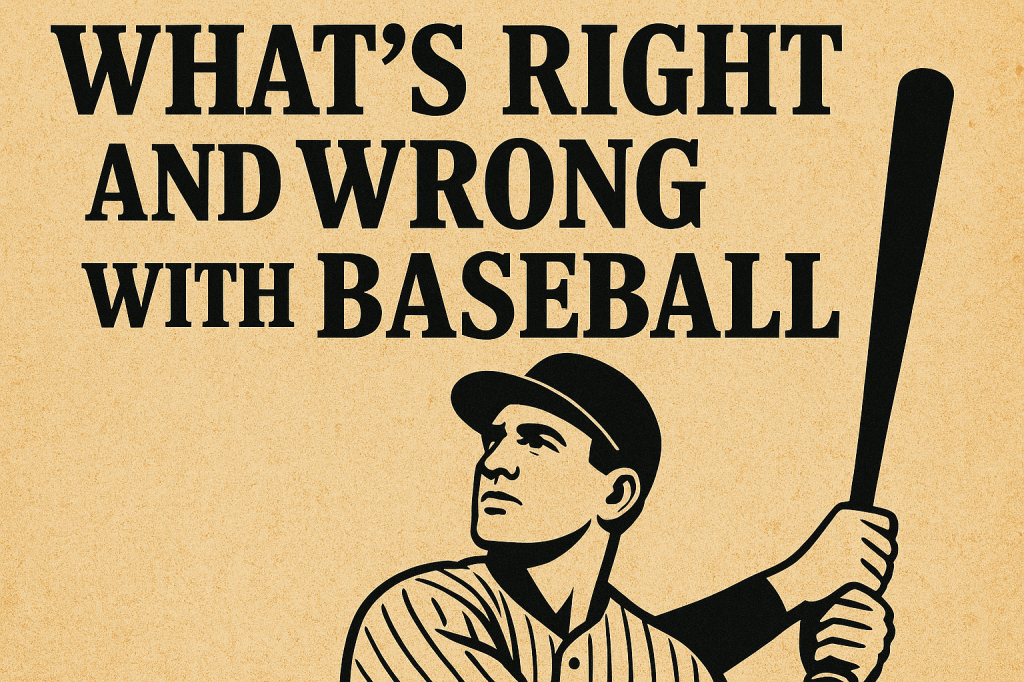
There was a time when baseball rewarded balance. When lineups could beat you in more ways than one — with power, precision, speed, and smarts. When championships were won not just by metrics, but by instincts.
That version of the game still exists — but only in pockets. In too many places, and especially in the Bronx, baseball has become an exercise in overthinking. The sport’s oldest truths have been replaced by spreadsheets and probability charts. The New York Yankees, once the embodiment of baseball’s greatness, have become its most glaring case study in how not to build a winner.
The Boom-or-Bust Philosophy
Brian Cashman’s Yankees have come to embody a philosophy that might work in a video game, but not in October: home runs or nothing. Every offseason, every trade deadline, every lineup card is a tribute to the long ball. The result? A team that can demolish middling pitching in July but looks lost when the calendar turns to fall.
The boom-or-bust style is exciting for the highlight reels but disastrous for the postseason, where the lights are harsher, the pitching elite, and the margin for error razor-thin. The Yankees don’t adjust, don’t shorten swings, and don’t manufacture runs. They wait for the three-run homer that never comes.
The days of situational hitting — bunting a runner over, taking the extra base, sacrificing for a teammate — are relics of another era. Those plays don’t show up well on a launch-angle chart, so they’ve been phased out. But it’s precisely those moments, the small ball nuances, that decide playoff games.
Analytics Without Instinct
Let’s be clear: analytics have value. They’ve modernized scouting, improved player conditioning, and helped small-market teams compete. But baseball’s current obsession with numbers has gone from helpful to harmful.
You can’t quantify a player’s heartbeat in the ninth inning. You can’t measure a veteran’s ability to read a pitcher’s tell, or a catcher’s intuition behind the plate. Those are the traits that win when everything else breaks down — the very elements the Yankees, and much of baseball, have ignored.
Cashman’s Yankees aren’t just using analytics; they’re enslaved to them. They’ve built a team for algorithms, not atmospheres. They chase spin rate and exit velocity, then wonder why their players can’t adapt when pitchers start carving the edges of the zone. The postseason isn’t a math problem. It’s a brawl fought between nerves and nuance.
A League Losing Its Identity
This isn’t just a Bronx problem — it’s a baseball problem. Across the league, clubs have adopted the same sterile, data-driven blueprint. Every hitter is taught to lift, every pitcher to chase strikeouts, every manager to manage by spreadsheet. The individuality of the game — the personality, the rhythm, the improvisation — has been stripped away in favor of conformity.
Games that once thrived on movement and anticipation now stall under endless strikeouts and walks. The sport’s pace problem isn’t just about time; it’s about texture. The excitement used to come from watching teams create runs — hit-and-runs, double steals, squeeze plays. Now it’s all waiting for someone to hit a ball 430 feet.
Toronto, and the Reminder of What Works
And yet, there are still teams that play the game the right way. Look north to Toronto, where the Blue Jays have quietly rebuilt themselves into a model of balance and adaptability. They don’t just swing for the fences — they play the full game. They advance runners, hit behind them, defend aggressively, and run the bases with purpose.
When they faced the Yankees this postseason, the contrast was glaring. Toronto didn’t overpower New York; they outclassed them. They executed. They adjusted. They forced the Yankees to play real baseball — something the Bronx Bombers, for all their payroll, have seemingly forgotten how to do.
The Jays are proof that analytics and instincts don’t have to be enemies. They use data to support strategy, not dictate it. Their approach is modern, but their identity remains rooted in the game’s fundamentals — and that’s why they’re ascending while the Yankees are perpetually explaining their failures in another postmortem press conference.
Brian Cashman’s Legacy of Stubbornness
Brian Cashman deserves credit for longevity. Twenty-six years in one of the most demanding markets in sports is no small feat. But tenure isn’t the same as success, and the truth is unavoidable: since 2009, the Yankees have been pretenders dressed as contenders.
Cashman’s refusal to adapt has become the organization’s defining flaw. Every year brings a new excuse — injuries, bad luck, timing — but the core problem is philosophical. He’s trying to outsmart a sport that punishes arrogance.
The Yankees are stuck in a cycle of their own making: overvaluing power, undervaluing contact, and mistaking spending for strategy. They’ve turned a simple game into a science experiment, and the lab keeps exploding in their faces every October.
Baseball Still Works — If You Let It
The irony is that baseball hasn’t changed as much as people think. The rules have evolved, the technology has advanced, but the essence remains the same. The teams that win are still the ones that execute the fundamentals, stay mentally sharp, and play for each other rather than the analytics department.
You can’t replace baseball’s soul with statistics. You can only use numbers to sharpen its edges. The Blue Jays and Dodgers, Orioles, and even the Rays — clubs that marry intelligence with intuition — understand that. The Yankees, trapped in their own self-made data maze, do not.
Until Cashman and the rest of baseball’s analytics zealots remember that this is a game played by human beings — not projections — the sport will continue to drift toward sterility.
Baseball doesn’t need to be reinvented. It just needs to be respected.
Because what’s right with baseball has never changed: it rewards the team that adapts, competes, and plays the game the way it was meant to be played. What’s wrong is thinking you’re smarter than it.
Mike Colón is the host of the Mic’d In New Haven Podcast which can be found on all podcast platforms and is simulcast in video form on YouTube
 Mike Colón Media
Leave a comment