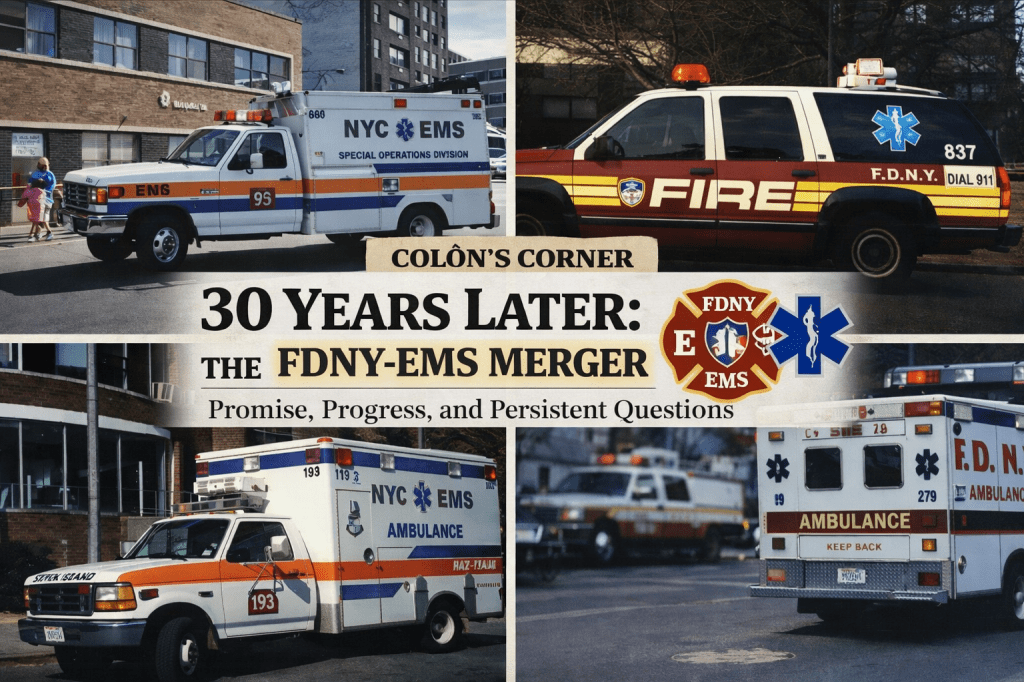
By Mike Colón
There are moments in public safety that don’t just change policy — they change identity.
March 1996 was one of them.
When New York City brought its municipal EMS system under the umbrella of the Fire Department of the City of New York, it wasn’t just a bureaucratic move. It was a gamble — one rooted in the belief that fire suppression and prehospital care, operating under one command, could deliver faster, more coordinated, and more effective service to a city that demands nothing less.
Thirty years later, the question isn’t whether the merger mattered. It’s how well it worked — and at what cost.
The Promise of One Department
On paper, the concept made sense. Firefighters and EMTs responding under a unified structure, sharing resources, communications, and command. Fewer silos. Faster decisions. A more cohesive response to emergencies that don’t fit neatly into categories.
And in many ways, that promise has been realized.
Major incidents — from high-rise fires to multi-casualty events — are handled today with a level of coordination that would have been far more difficult in a divided system. The Incident Command System matured. Interoperability improved. Dispatch integration became more refined.
You see it on the fireground, at trauma scenes, and during citywide emergencies: a level of synchronization that reflects years of working side by side.
The merger forced two cultures to learn each other. And over time, that familiarity has saved lives.
Two Cultures, One Patch — Not Always Seamless
But culture doesn’t merge as easily as command charts.
From the beginning, the FDNY and NYC EMS came into the relationship with different histories, different identities, and, perhaps most importantly, different levels of institutional recognition. Firefighters were — and remain — one of the most visible and celebrated forces in the city. EMS, despite being the backbone of prehospital care, has long fought for the same level of respect, resources, and compensation.
That imbalance didn’t disappear in 1996. In many ways, it became more pronounced.
EMS personnel became part of the FDNY, but often felt like they were not of the FDNY. Differences in pay, career mobility, and promotional pathways created a divide that no amount of shared patches could fully bridge.
Thirty years later, that tension still exists — not always loudly, but persistently.
Operational Reality: Better Together — But Not Equal
From an operational standpoint, there’s no denying the improvements.
Response models have evolved. Joint operations are smoother. Fire companies and EMS units understand each other’s roles better than ever before. The city’s ability to manage large-scale emergencies — from natural disasters to acts of terror — has benefited from a unified command structure.
But operational success doesn’t always translate to organizational equity.
EMS continues to carry a disproportionate share of call volume — the overwhelming majority of 911 runs in New York City are medical. Yet staffing challenges, burnout, and retention issues remain ongoing concerns.
The merger created a system where EMS is indispensable — but not always adequately supported.
And that’s where the conversation shifts from structure to sustainability.
The Successes That Can’t Be Ignored
It would be incomplete — and unfair — to frame the merger solely through its challenges.
Over three decades, the FDNY-EMS system has responded to some of the most defining moments in the city’s history. From September 11th to Hurricane Sandy to the COVID-19 pandemic, the integration of fire and EMS has proven its value under the most extreme conditions imaginable.
Lives have been saved because units were closer. Because communication was clearer. Because command was unified.
There is no question that, in moments of crisis, the system works.
The Questions That Still Remain
But anniversaries aren’t just about reflection — they’re about accountability.
Thirty years in, the questions are no longer theoretical. They’re practical:
Has EMS achieved true parity within the department? Are career pathways aligned in a way that reflects the importance of both services? Is the system built to retain the people it depends on most?
Because a merger isn’t a one-time event. It’s a living system that either evolves — or stagnates.
Where Things Stand Today
Today’s FDNY is stronger, more capable, and more integrated than it was in 1996. There’s no debating that.
But it’s also a department still navigating the realities of a decision made three decades ago. The operational benefits are clear. The cultural and structural challenges are just as real.
The merger didn’t fail. But it didn’t fully finish, either.
And maybe that’s the most honest way to look at it.
Looking Ahead
The future of the FDNY-EMS relationship won’t be defined by what was done in 1996, but by what’s done next.
Because the goal was never just to combine two services. It was to strengthen both.
Thirty years later, the foundation is there. The question is whether the city is willing to build on it — not just operationally, but institutionally.
Because in a city like New York, where seconds matter and systems are tested daily, the difference between good and great isn’t structure.
It’s how you take care of the people inside it.
 Mike Colón Media
Leave a comment